

Great things are done when men and mountains meet.
William Blake
It doesn’t happen in the streets.
What’s Provence without her St. Victoire?
The first time I climbed this great mountain of Provence was on my first visit to the region in 2005. Having trekked around the world and criss-crossed the Negev several times I considered myself a tough cookie. I didn’t know that this is the symbol of Provence, a mystical mountain, a legend – Paul Cezanne’s mountain. I blindly followed my partner up to the top. However, instead of taking the gentle blue tourist trail, which after 2-3 hours of steady hiking up you reach the refuge, my partner, unbeknownst to me, decided to take the extremely difficult black, mostly unmarked trail, of the south face.
The Impregnable South Face at Pitch Darkness
Only when I reached the gully full of sliding gravel did I think that this is maybe too much. The scrambling was exhausting and soon I was spitting blood and cursing my partner who knew better than to reply. He carried on up, I bit my lip and followed. Finally, almost at dark we reach “the hole”, the cave which is a sign that we are nearly at top. Another half an hour or so in total darkness on the plateau ridge and I blasted open the door to the priory- an old monastery converted into an unmanned refuge open to all.
My anger quickly subsided when I found warm fire in the fireplace, a bottle of champagne and a bunch of edible goodies left by recent hikers who evidently just left. Such is the hikers code in the mountain, to leave gifts for others. Or perhaps they just didn’t feel like carrying all this stuff back down the mountain. It was a bit bizarre, like somebody left in mid dinner and just disappeared. Champagne almost full and still bubbling, chocolate, cheese and a warm fresh fire. They could not be far judging by the fire.
We gorged ourselves on food and exhausted as I was I buried myself inside my sleeping bag just wanting to sleep. My partner did the same, when he heard footsteps outside. He went out to look, but nothing. I feel sleep. In the morning he informed me that the footsteps came back, but there was nobody. The ghosts of the mountain? Of Cezanne? They left the champagne and the fire for us?
Such is the mystical mountain with the famous 19 meter high ‘Cross of Provence’ which I never did get to properly see due to the very late hour.
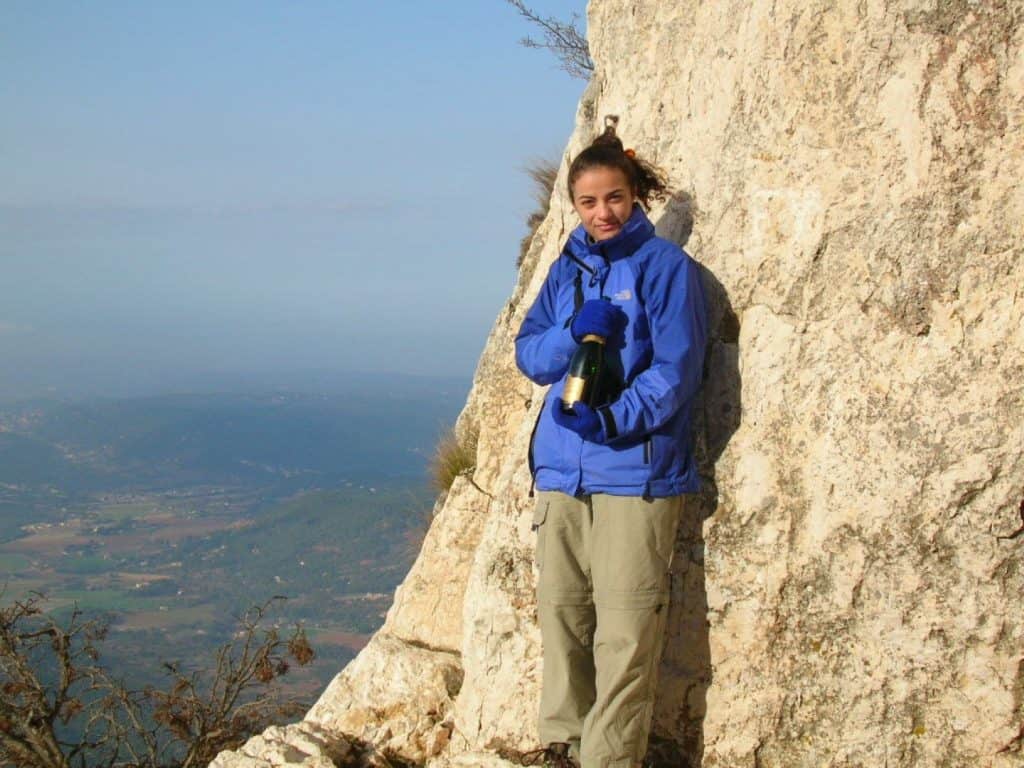
Gift from the mountain: Champagne 
View from the “Monks’ notch”
The Kiddie Blue Trail of the North Face
The second time I climbed the mountain I had kids already, none of which can do the ‘tourist trail’ to the top. The 1 year old could not be left at home to be cared for by a French grandmother who also had her 3 year old brother to deal with. We left the three year old with Mami and carried the one year old up the mountain in December on a particularly sunny and crisp day. Covered up from head to toe and a blanket, the one year old didn’t really appreciate the extremely cosy way she was climbing the mountain. She whined the entire way until she finally fell asleep and we could hike in peace and quiet.
Arriving at the top, it was below freezing temperature and I mostly stayed inside the refuge with the toddler and let her romp around and stretch her legs. Again, the famous cross was missed, this time due to a fussy 1 year old.
At the top, there’s another mountain
Years later, once school-aged children emancipated their mother to do what she does best, I climbed Cezanne’s mountain again, this time for myself, by myself, my way.
I arrived at the Bimont parking lot near the dam. From there I cut into the forest and the path is quite clear with the blue trail markings. After half an hour there are no more trees, only bushes and stones. The reddish soil is also gone. I stop, there is no one behind me to wait for, or someone ahead I need to catch up to. Stopping where I want, continuing at my own pace. And here you can already see the cross. Close, but I know it’s only half way.

The Cross: So close, yet far 
almost there…
After an hour I reach the monastery at an altitude of 888, this time I continue straight to the cross. And under the huge cross I feel rather small and wretched. The mountain is legendary and I am only human. I conquered the mountain, but there is another mountain. There always is. And to access the next mountain you have to go down the current one. A nasty task, annoying and sometimes boring. But it’s like in life, there are no ascents and summits without the obligatory descents and valleys.
Eyes to the mountains
The St. Victoire massif, rising from the Mediterranean plains with its immaculate rocks, exerts an extraordinary appeal even if observed from a distance. Sainte-Victoire has different summits lined up along the ridge, amongst these summits the most famous is the Croix de Provence at 946m with its 19 metres high cross. Although not placed on the highest point of the mountain, it stands out from the ridge far more than the Baou des Vespres and Pic des Mouches summits and can be seen as far as 10km.
The massif is mainly built by beautiful white and grey limestone rock, while in the lower part other rock structures like the conglomerates can be observed. This give the mountain a range of palette of vivid colors. The two sides of the massif are very different: to the North a steppe which at the bottom land gives way to oaks and pines. To the South a seemingly insurmountable sunny wall, mostly a sheer, almost vertical drop, while the Northern side is far less steep.
West of the mountain is the well known town Aix en Provence. To the north east, two artificial lakes can be seen. The dam of the lower one is called Barrage Zola, after its architect Francesco Zola, the father of the famous writer Emile Zola. This dam and the higher Barrage de Bimont were constructed already in the middle of 19th century, ensuring manageable water resources for the whole area.
Closer to God: A Cross is Raised
The mountain has a long and rich history. Below it, fierce battles between Ancient Romans and the neighboring tribes took place. On the southern side remains of an ancient town can be seen. Later, the western summit – the Cross of Provence – became widely known for pilgrimage. In the 13th century, a chapel dedicated to “Sainte Venture”, as the mountain was once also called, was built just below the summit of the Cross of Provence on the Monks’ Notch at 888 m. Today we can see the building of the Priory which stands there since the 17th century. It is called Notre-Dame-de-Ste-Victoire and on top of the nearby summit a 19 m high cross was erected.
To Fix or Not to Fix
Three wooden crosses are successively erected at the top of the massif, but none can withstand the storms. The current cross of Provence was erected in 1875 at the initiative of Father Meissonnier.
The parish priest of Rousset wants to thank God for protecting the region from the Prussian invasion and smallpox. This giant metal, 19 meters high and located at almost 1000 meters above sea level, quickly became a place of pilgrimage. Thirty years after its erection, the monument, shaken by storms and frost, threatens ruin. Consolidation work began in 1910, 1925 and 1982. In 2002, lightning struck the pedestal, pulverizing 700 kilograms of stone. The site is immediately forbidden. Given the scale of the work, whose cost was around 300,000 euros, voices were raised to demand the disassembly pure and simple of the monument.
The rich department and the community of Aix finally decide to finance the renovation of the cross and endow it with a system of protection against lightning. Thus, one hundred and forty years after its inauguration, the monument is still standing. What would be Sainte-Victoire without his cross of Provence? It’s like imagining Rio de Janerio without its iconic Christ the Redeemer with open arms high above the city.
The Burning Mountain of Cezanne
In 1989 a huge fire devastated 5000 hectars of forests and the mountain has still been recovering from that. It is said that in summer the access is restricted, but otherwise hikes on top are very popular. It is estimated that 700 000 people ascend it each year. Another tourist info center is situated on the other side, on the North, in the nice village of Vauvenargues, which is well known because of the famous Pablo Picasso who bought a small castle there and he is buried nearby.
On the Western side every stone and tree reminds of Paul Cézanne, who lived below the mountain and painted there. Montagne Sainte-Victoire is often referred simply as the “Cézanne’s mountain” who painted the mountain incessantly between 1868 and 1906 and 87 of those painting survived and are displayed around the world.
Paul Cezanne himself eventually found his death on the mountain. One day while painting on the mountain he got caught in a vicious thunderstorm. He trekked back two hours to his mountain studio in the storm, but the damage was done. He caught a lung infection and died 3 days later.
Note: Even in the friendly blue trail, we are talking about an ascent of over 500 meters. Not suitable for children under 7. Not to be attempted during the hot summer months.


2 Responses
Thank You for sharing your vivid and exhilarating experiences with this Mountain. I am preparing a study presentation for a Sophia Group study meeting. (A Soka Gakkai International women’s group) Your detailed information of the landscape, the highs and lows of your journey’s with your desire to create milestone returning visits inspires me deeply.
My Pleasure! Glad you enjoyed it as it’s a great mountain.